

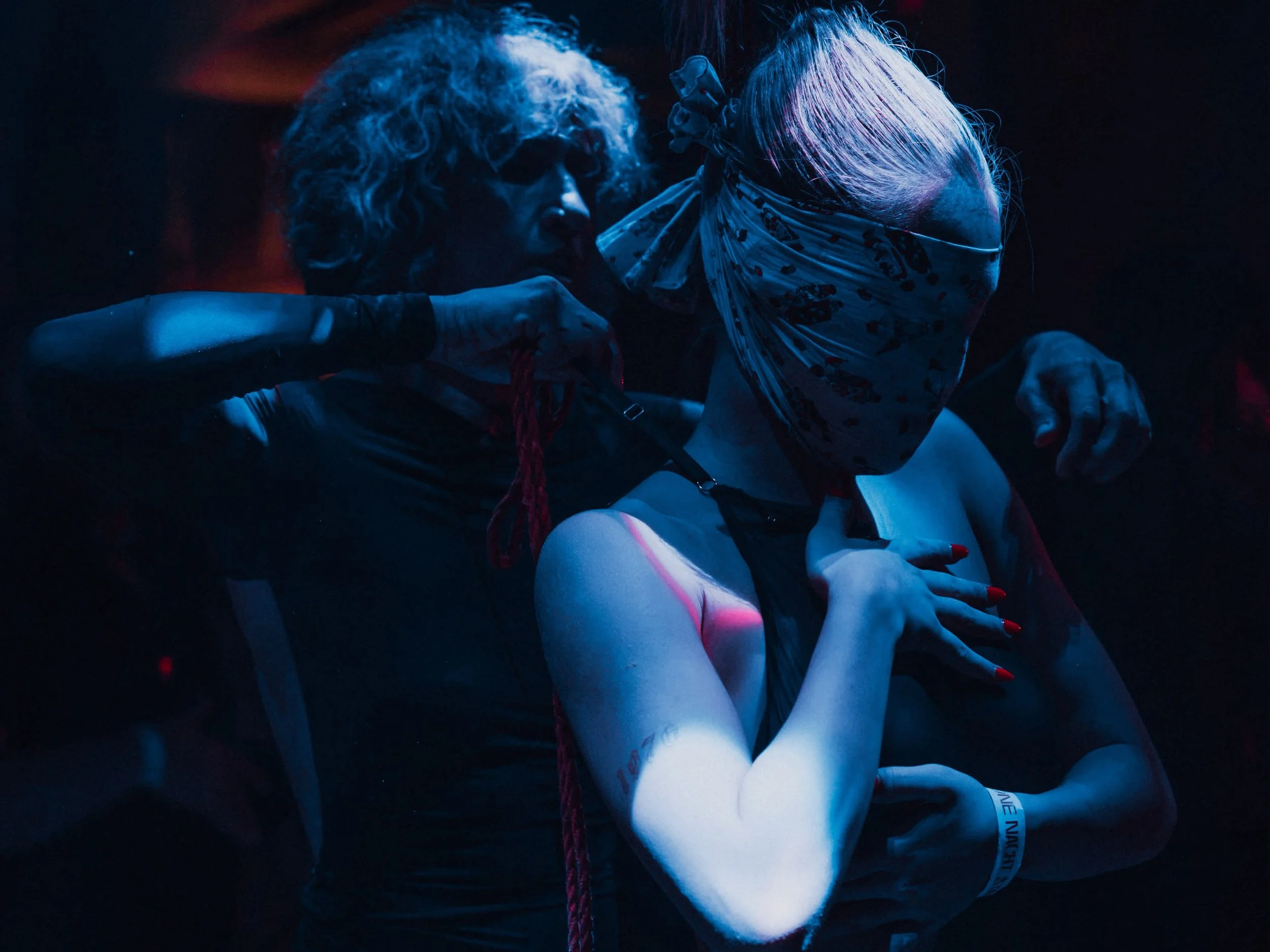
Discover Shibari through Yulia Shibari's approach to rope, body awareness, trust, artistic form, movement and living art.
What Is Shibari?
Shibari Begins With Curiosity
For me, Shibari begins with curiosity. It is a way of exploring: rope, the body, sensation, and the space between two people. Every session, every performance and every workshop starts with a question rather than an answer.
It is also an exploration of both people. I am discovering my own boundaries as much as the boundaries of the person I am working with. Nothing is entirely fixed, and that is part of what makes it so alive.
The Body and the Boundaries
Shibari is about the body, sensation, awareness and trust. Rope gives the body something to respond to. It brings attention to breath, to tension, to the places we hold without noticing.
Many people experience deep relaxation, a feeling of releasing physical and emotional tension. Some describe the sensation afterwards as similar to the release after a very good full-body massage: heavy, quiet and softly open.
Shibari as Living Form
For me, Shibari is also very much about creating form. I often compare it to Ikebana: the body, rope and space become the elements of a composition. Rope changes the geometry of the body, and the lines it creates can transform a figure completely.
Every body is different, so every composition is different. Every space changes it again. The same structure on two people, or in two rooms, becomes two different works.
The Intelligence of Rope
There is a strong technical and intellectual side to Shibari. I think about tension, structure, balance, mechanics and the distribution of weight. It is a constant exercise in problem-solving.
This is especially true in suspension work, where I really enjoy the engineering aspect and having my brain fully engaged. The challenge is to solve a technical problem and create something beautiful at the same time, while staying attentive to the person in the ropes.
Trust and Communication
Trust is central to everything I do. There is always clear communication, there are clear boundaries, and there is the possibility to stop the experience at any moment.
This is not a limitation on the art. When both people feel safe, there is far more freedom to explore, to let go and to create.
Beyond the Stereotypes
I want to move away from the idea that Shibari is simply pornography, BDSM or domination. Those contexts can exist, but Shibari itself is much wider. It can be artistic, meditative, physical, intellectual and deeply personal.
It can be sensual without being explicit, and intense without being aggressive. What it becomes depends on the intention and the people involved.
Shibari as Living Art
Sometimes Shibari becomes Living Art: a live creation in which the body, rope, movement, space and audience all become part of the artwork. The process is the performance. People watch the lines appear and the figure change, and their attention becomes part of the energy that shapes the piece.
A Shared Experience
In some formats I also work with groups. Participants become part of the process and create a collective rope artwork together, an Ikebana made from people.
Whether it is a private session, a stage performance or an immersive experience, Shibari is always a shared experience: between people, between rope and body, and between each person and their own inner world.
If you feel curious, I invite you to explore my work: Private Sessions, Living Art, Performances and Immersive Experiences. Or, if you are ready to begin, book a private experience.